What you'll get
Software Review
iClosed Review: Is It Worth It for High-Ticket Sales?
iClosed captures leads, qualifies prospects, and tracks every deal in one tool. Our honest review covers pricing, features, and who should buy it.

Founder & Editor
You spend $3,000 on ads. Eighty people view your form. Twenty-two start booking a call. Fourteen drop off before they ever pick a slot. Of the eight who do book, three ghost you. You take five calls. You close one. That is a $3,000 cost per client, and almost all of the bleed happened before a single conversation took place. The brutal part is that most of those lost people were not bad leads. They were leads your funnel simply failed to hold onto.
iClosed was built to plug that exact gap. It captures prospect data before it shows the calendar, disqualifies the leads who would waste your closers' time, routes the qualified ones to the right rep, then tracks every deal from booked to closed. The pitch is blunt: stop leaking revenue before the call even happens. It is not a CRM, not a dialer, not a magic AI closer. It is the booking and qualification layer that high-ticket teams usually try to duct-tape together out of Calendly, a Google Form, a Zapier chain, and a spreadsheet.
This review covers what iClosed does genuinely well, where it falls short, who it is built for, and whether the $120/month Business plan earns its keep for a coaching or agency business doing $30K to $200K a month. It also covers the piece almost every other iClosed review skips: what to do after you close on the call. Booking more calls is worthless if the payment you collect on a $10,000 deal gets frozen for ninety days. The processor you use matters as much as the call itself, and we end on exactly that.
What iClosed actually does
Before the feature list, here is the mental model. iClosed sits in one specific spot: between your ad or landing page and your closer's calendar. That is the whole job. It replaces the makeshift stack most high-ticket teams assemble from parts (a scheduler, a separate lead form, an automation tool, and a spreadsheet to track who closed what). Once you see it that way, the product gets simple to evaluate.
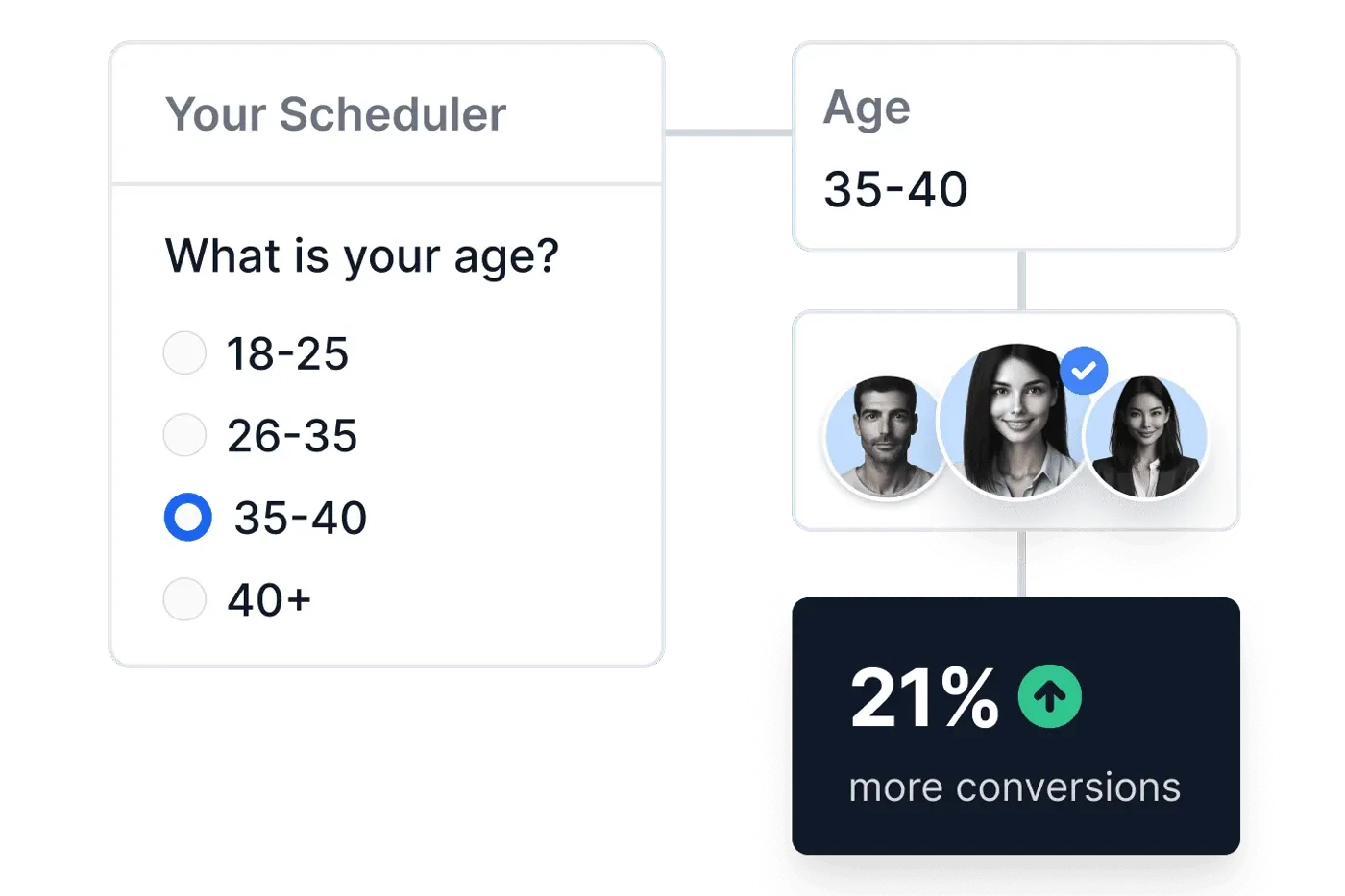
Three functions explain almost everything it does. Capture: it collects lead info (name, email, phone, qualification answers) before the calendar ever appears, so even a prospect who bounces without booking is no longer lost. Qualify and route: it auto-disqualifies leads who fail your criteria (budget, geography, custom fields) and routes the qualified ones to the right closer based on rules you set. Track: it surfaces show rate, close rate, revenue per call, and pipeline value for every rep in one dashboard. That is the entire value proposition, and it is a coherent one. If your high-ticket funnel leaks at booking, iClosed addresses the leak directly, and you can try iClosed free here before committing to anything.
One honest framing note. iClosed's homepage leans on "AI" language. In practice the engine is rules-based form gating and conditional routing, not generative AI. That is not a knock. Rules-based routing is exactly what a high-ticket booking flow needs, but you should buy it for what it is rather than for the marketing label.
Features breakdown
Going feature by feature is only useful if every feature answers one question: what does this actually mean for a high-ticket seller? Here is each one against that test.
Lead capture before booking
This is the multi-step form that collects lead data before the time slots appear. iClosed says standard booking flows lose a large majority of visitors before they pick a slot, and that capturing data first recovers a meaningful share of them (iClosed cites figures as high as "200% more leads" and, in named testimonials, "758 extra leads in the first week", attributed to Remy Jupille, and an "8x" lift in lead generation, attributed to Leila Belmiahi). Treat those as individual case results reported by iClosed, not guarantees. The mechanism, though, is real: if 100 people land on your booking page each week and 70 leave before choosing a slot, capturing those 70 first means your setter can follow up instead of losing them forever.
Lead disqualification and routing
iClosed can filter on geography, budget range, email type, custom form fields, and (on the Business plan) credit data. Leads who fail are redirected somewhere else: a lower-ticket offer, a waitlist, or a nurture sequence, instead of cluttering a closer's calendar. Conditional routing, also a Business-plan feature, assigns the qualified leads to specific reps by rule. For an agency running three closers with different specialties, that means the right prospect lands on the right rep automatically, with no daily Slack scramble over who takes which lead.
SMS and email workflows
Automated reminder sequences fire before the call and follow up after booking, which is the lever that pulls no-show rates down. These workflows are available on both Startup and Business. iClosed positions no-show reduction as a core benefit, but it does not publish a specific platform-wide percentage, so we are not going to invent one. What we can say is that timed reminders demonstrably beat no reminders, which is consistent with how booking behaves generally.
Pipeline and deal tracking
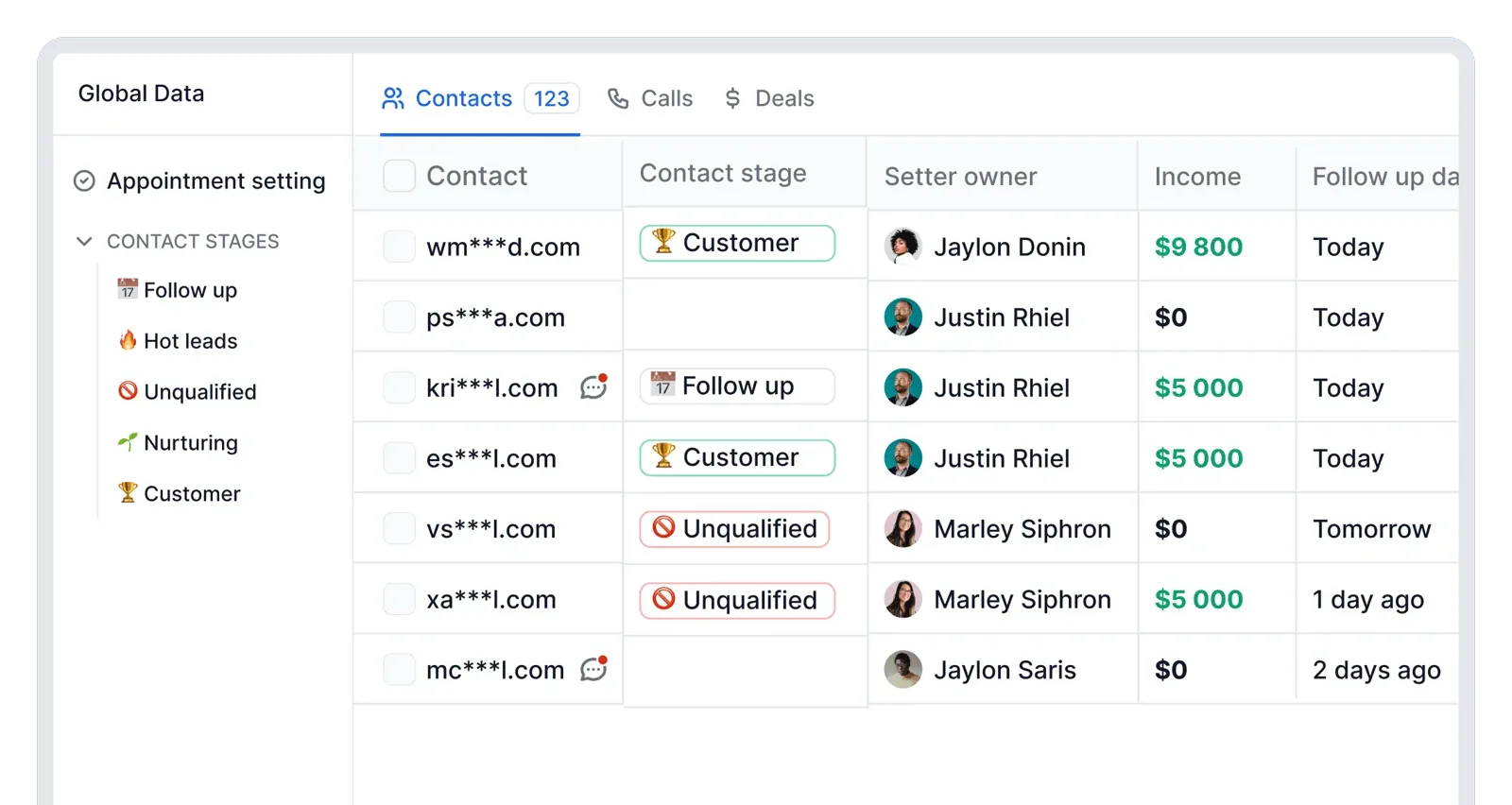
iClosed tracks show rate, close rate, revenue per call, and total pipeline value by rep, described as "basic sales tracking" on Startup and "advanced sales tracking" on Business. CRM sync (HubSpot, Pipedrive, Close, Make) is Business-only; Zapier and Slack are on both. The integration that matters most for paid-ads teams is Hyros (Business plan), which attributes ad spend to closed deals, not just booked calls. Most Calendly users have zero visibility into which rep closes what percentage of calls. iClosed gives you that without you building a CRM from scratch.
New in 2026 Credit score enrichment
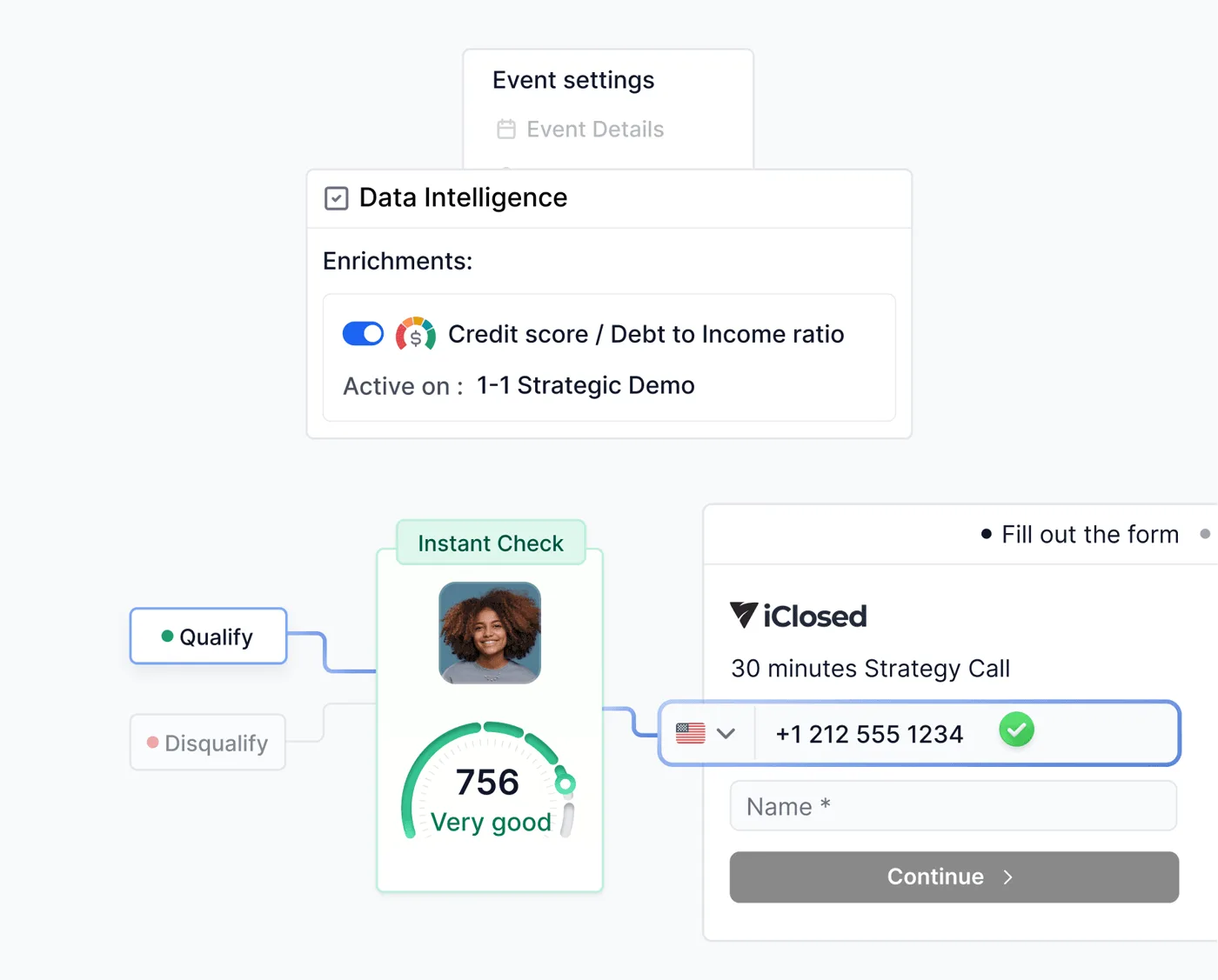
The newest Business-plan feature, and the one with no equivalent anywhere in the scheduling market: iClosed can enrich inbound leads with real credit data (credit score band, debt-to-income ratio) and qualify or disqualify them before they reach a calendar slot. For B2C high-ticket offers where financing is part of the sale (real-estate coaching, business credit programs, $15K masterminds), this answers the question every closer asks ten minutes into a dead call: can this person actually buy? The honest read: some coaches will find this genuinely useful, others will find it unnecessary or uncomfortable. It is a real feature, not a gimmick, and how much it helps depends entirely on your offer and your standards for who you let onto a call.
What works
- Lead capture before booking recovers prospects who would otherwise disappear from your funnel
- Disqualification protects closer time from tire-kickers and unqualified bookings
- Rep-level analytics (show rate, close rate, revenue per call) give managers real pipeline visibility
- Native HubSpot, Pipedrive, and Close integrations, plus Zapier reach for almost any other CRM
- Hyros integration ties ad spend directly to closed revenue, not just to bookings
- Credit-score enrichment (Business) adds a qualification layer Calendly has no equivalent for
- 7-day free trial on both paid plans, and iClosed says setup takes about five minutes
What hurts
- Business at $120/month per seat scales fast: three closers is $360/month minimum
- No-show reduction is not backed by an independently verified platform-wide figure
- The "AI" branding oversells what is primarily rules-based form routing
- Pipeline tracking is lighter than a real CRM (no Kanban board, no deal notes, no email-thread tracking)
- The Stripe/payment integration is Business-only and booking-oriented, not a full checkout
- No published money-back guarantee beyond the 7-day trial
- Enterprise pricing is opaque and requires a sales conversation
iClosed pricing: what you actually pay
Most iClosed reviews either skip pricing or paste the marketing page without explaining the per-seat model, which is the part that actually drives your bill. Here is the clear version. According to iClosed's pricing page, the plans break down as follows. Note that iClosed updates its pricing periodically, so confirm the current numbers on iClosed's site before you buy.
Startup, $24/month per seat (about $19 on annual billing). Includes a 7-day free trial, and the 20% annual discount brings the per-seat price down to roughly $19. You get unlimited leads and events, instant lead capture, the 2-step scheduler, SMS and email reminders, country disqualification, Calendly import, global data tracking, basic sales tracking, the lift pop-up, Google and Zoom integration, Meta and Google tag manager, Zapier and Slack, and API access.
Business, $120/month per seat, about $96 on annual billing (iClosed's "most popular" tier). Includes the 7-day trial and the same 20% annual discount. On top of everything in Startup, you get advanced sales tracking, advanced disqualification, conditional routing, appointment setting, workflow automations, advanced scheduling analytics, IP and email blocking, custom roles, the native CRM integrations (HubSpot, Make, Pipedrive, Close), the Stripe/payment-processor integration, Hyros, and the credit-check data layer.
Enterprise, custom pricing. Contact sales. Adds migration support, a technical implementation specialist, and direct Slack support.
The per-seat model is the real cost driver, and it is the one decision point worth flagging clearly. A solo coach with no setter uses one seat. A team of two closers and a setter on Business is $360/month. That is not a gotcha, it is just math you should do before you sign up. For context, Calendly runs roughly $10 (Standard) to $16 (Teams) per seat on annual billing, and Acuity is flat rather than per seat. iClosed's premium is real. So is the feature gap: neither Calendly nor Acuity captures leads before booking, disqualifies them, or tracks close rate by rep.
| Feature | Startup ($24/seat) | Business ($120/seat) |
|---|---|---|
| Lead capture before booking | Yes | Yes |
| Lead disqualification | Country only | Advanced |
| Conditional routing | No | Yes |
| SMS + email reminders | Yes | Yes |
| Basic sales analytics | Yes | Yes |
| Advanced analytics | No | Yes |
| CRM integrations (HubSpot, Pipedrive, Close) | Via Zapier | Native |
| Hyros integration | No | Yes |
| Credit score enrichment | No | Yes |
| Custom roles | No | Yes |
| Workflow automations | No | Yes |
| Price per seat | $24/mo ($19 annual) | $120/mo ($96 annual) |
Pricing per iClosed's published plans. Verify current figures on iClosed's site before purchase.
Try iClosed free for 7 days
Set up in under five minutes. Capture leads before they bounce, qualify prospects automatically, and track every deal through to close.
Start your free trialAffiliate link. Earns us a commission at no extra cost to you.
Who builds iClosed: the Ismael Esnousi story

Most schedulers are built by product managers; iClosed was built by a closer. The founder's path, in short:
- Ismael Esnousi, French high-ticket sales expert, started as a closer, then ran and trained closing teams.
- Built Closing Mastery and Setting Mastery, two of the best-known closing and setting training programs in the French-speaking market.
- Phase two: industrialized that qualification playbook into software, iClosed.
- The product reads like it: qualification-first booking, disqualification rules, rep-level close-rate dashboard. Every feature maps to a real sales-floor problem he lived.
Two honest caveats:
- Closing education is a polarizing industry: Closing Mastery holds a mixed 3.8/5 on Trustpilot (640+ reviews). Judge the software separately: iClosed sits at 4.4/5 on Trustpilot (small volume) and 5.0 on G2.
- The flagship numbers ($4.3B recovered pipeline, 20,000+ sales pros) are vendor claims, not audited.
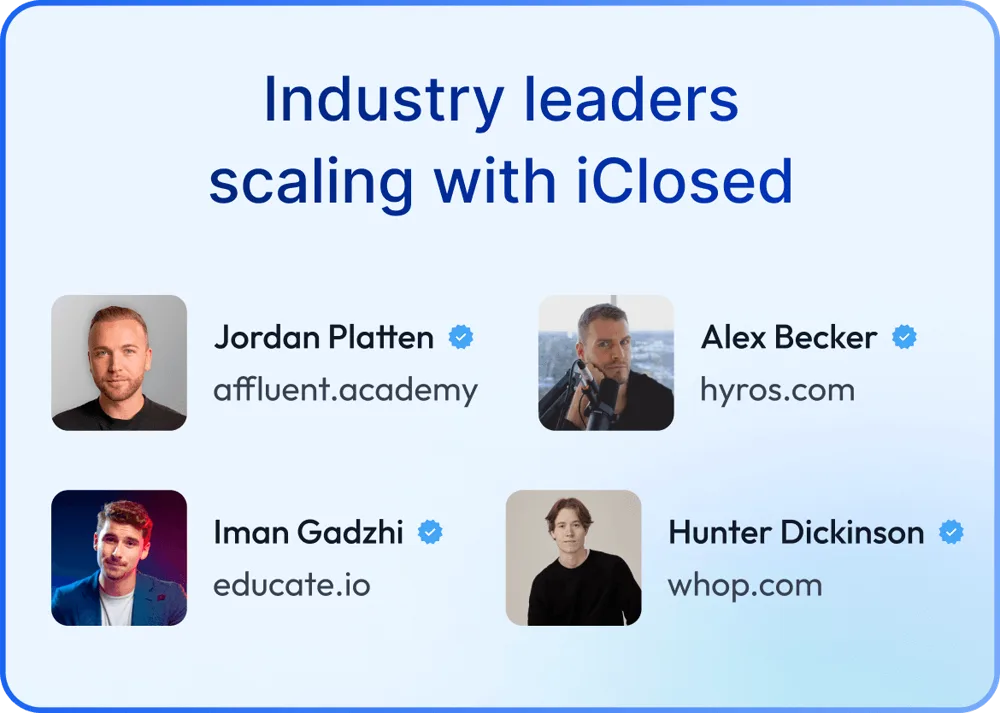
What is externally checkable is who chose the tool: Alex Becker (Hyros), Iman Gadzhi (Educate.io), Hunter Dickinson (Whop), Jordan Platten (Affluent.academy). People who sell qualification for a living picked the qualification scheduler. That beats any testimonial paragraph.
Who iClosed is for
"It's for anyone running sales calls" is a useless answer. Here is the specific version.
The sweet spot: high-ticket coaches and agency owners
If you run a $3K to $25K offer on paid traffic (Meta, YouTube, Google) with at least one closer on the calendar, iClosed Business at $120/seat is usually cost-justified inside the first week. One extra deal recovered from a previously lost lead pays for two or more months of the tool. The Hyros integration makes it especially strong for teams spending $5,000+/month on ads, because you can trace which campaign produced which closed deal, not just which booking. iClosed reports aggregate and named results in this band ("$4.3B recovered in high-ticket pipeline" as a platform claim, and "$129K just from the extra leads" attributed to Kevin Godawski); read those as iClosed's own figures rather than independently audited numbers. This is also where the back half of your stack starts to matter: once iClosed books and you close the deal, you need somewhere safe to collect the money. We sell high-ticket on Whop and add iClosed as the booking layer in front of it.
Solo coaches and setters on the Startup plan
If you book your own calls and have no setter team, Startup at $24/seat (about $19 on annual billing) gives you the lead capture and reminder workflows, which is the part that actually shifts your numbers at this stage. The CRM sync, routing, and advanced analytics are unnecessary until a second person is on the calendar. Honest comparison: at $24, Startup competes directly with a Calendly Standard plan plus a Typeform lead-capture form. iClosed folds both into one tool and adds the sales-specific analytics layer, so the value holds even solo, but it is not a decisive win at this tier.
Who should not use iClosed
Service businesses booking general appointments (salons, clinics, personal trainers) do not need lead qualification or pipeline analytics; Acuity or Calendly are cheaper and simpler for that. SaaS teams running product demos on top of a full CRM like Salesforce or HubSpot, with native scheduling already wired in, may not gain enough to justify replacing the stack. And bootstrapped solopreneurs doing fewer than ten calls a month will underuse even the Startup analytics; start on the free trial, see whether lead capture alone changes your numbers, and only then decide. Saying so is the point of an honest review.
iClosed vs Calendly: the real comparison
If you already use Calendly, this is your decision section, and it deserves a fair answer: Calendly is the better product for generic scheduling. Clean invitee experience, deep integrations, mature round-robin routing on Teams, excellent for SaaS demos and B2B meetings. iClosed wins on one specific job, high-ticket conversion, and loses on most others. They are different tools built for different work.
Calendly is a scheduling tool that is very good at scheduling. iClosed is a sales conversion tool that includes scheduling, where the booking flow is secondary to capture, qualification, and analytics. The entire difference compresses into one design decision: what happens first, the form or the calendar. Calendly shows slots immediately and treats the form as optional decoration, so a prospect who bounces leaves no trace and an unqualified one books straight onto your closer's calendar. iClosed inverts the sequence: qualification form first, calendar second, and the partially completed form is already saved. Even the abandoner leaves a name, an email and a phone number your setter can chase.
From that one inversion, everything else follows.
Where Calendly loses for high-ticket:
- No lead capture before booking: the abandoner leaves no trace.
- No native disqualification: anyone can grab any open slot.
- No deal tracking, no rep-level close-rate visibility.
- No Hyros or ad attribution, no credit enrichment.
- Routing Forms (paid tiers) send people to different calendars, but do not capture abandoners, score leads, or feed a pipeline.
Where iClosed loses to Calendly:
- Price: $24 to $120 per seat versus roughly $10 to $16.
- Invitee-side UI polish and enterprise scheduling maturity.
- Brand recognition: prospects trust the Calendly interface on sight.
The decision rule: average deal at $2,000 or more, iClosed; below that, Calendly's simplicity wins on math alone.
| Capability | iClosed | Calendly |
|---|---|---|
| Lead capture before booking | Yes | No |
| Lead disqualification | Yes | No |
| Rep routing | Conditional (Business) | Round-robin (Teams) |
| Deal pipeline | Yes | No |
| Close-rate tracking | Yes | No |
| Hyros / ad attribution | Yes (Business) | No |
| Price per seat | $24 to $120 | ~$10 to $16 |
| Free trial | 7 days | Free tier |
| Best for | High-ticket sales calls | Generic scheduling, SaaS demos |
Calendly pricing reflects annual per-seat billing and may change. Confirm current figures on Calendly's site.
The closing stack: iClosed plus Whop
Here is what every other iClosed review misses. They all stop at "you'll book more calls." But booking the call is only step one. What happens after you close on it? You have to collect the money, and for a $5K to $25K offer, the processor you pick will either protect you or eventually freeze you.
Most coaches who close high-ticket deals on a call try to run the payment through Stripe. Stripe is a developer payment tool, not a merchant of record. For high-ticket digital products, coaching programs, and community memberships, it regularly flags accounts, holds funds, and closes accounts with little notice. A single $10,000 charge on a brand-new Stripe account is exactly the kind of event that trips a review. Close a $10K deal on Monday's iClosed call and you want the money in your bank by Tuesday; Stripe may hold it for weeks or months instead. We documented the pattern in our guide to a Stripe account frozen without warning.
Whop solves the second half. It acts as Merchant of Record: you close the deal on the call, send the Whop checkout link, the buyer pays on Whop, and Whop handles VAT, disputes, and compliance so you are never fighting a chargeback alone. In Whop's own words, Whop automatically handles and fights disputes on your behalf, helping protect from holds and account closures. The fee is just 2.7% + $0.30 per transaction. No subscription required. No hidden costs. On a $5,000 coaching program that is $135.30, and it comes with merchant-of-record protection that raw Stripe does not give you. If you want the full mechanics, read how Whop's Merchant of Record model works and our pick for the best payment processor for coaching businesses. For clients who need to spread the cost, Whop also supports buy now pay later for high-ticket programs.
The full workflow is tight:
- Run paid traffic to a landing page with the iClosed booking widget embedded. (If you are still assembling that page, here is our take on the funnel builder to connect your ad to your booking page.)
- The lead fills out the qualification form. Unqualified leads go to a nurture sequence; qualified leads book a slot on your closer's calendar.
- SMS and email reminders fire automatically before the call, lifting your show rate.
- The call happens. You close the deal.
- The buyer pays through your Whop checkout link ($2K to $25K). Whop collects, handles VAT, fights disputes, and deposits to your bank.
This is the same payment layer the biggest creators run on. Iman Gadzhi made $25M+ on Whop. TJR runs $1M/month. Airrack hits $250K/month. All of it processed through Whop. The marketplace side helps too: with 22.5M+ users browsing for programs, a Whop listing adds discovery your ads never reached.
iClosed honest verdict
If you are running paid ads to a high-ticket offer and have at least one closer on the calendar, iClosed Business pays for itself with one recovered lead a month. The $120/seat price is real, but so is the result, and the Hyros integration alone earns its place for any team spending $3K+/month on ads. This one is easy: sign up, run the trial, do not overthink it.
If you are a solo coach self-booking calls, start with Startup at $24/seat (about $19 on annual billing) and run it for 60 days. If your show rate does not move measurably, the lead capture alone will still have added email addresses to your list that would otherwise have vanished. Upgrade to Business only when a second closer or a setter makes the routing and analytics worth paying for.
If you are booking fewer than ten calls a month with no paid traffic, save the money. Calendly's free or Standard tier does the job, and you can revisit iClosed when your volume justifies the analytics layer. When you are ready, start with the trial: try iClosed free for 7 days. We rate it 4 out of 5 for high-ticket teams, with the score held back only by the per-seat cost at scale and the gap between its "AI" branding and what the engine actually does.
Frequently asked questions
What is iClosed and how is it different from Calendly?
iClosed is a sales conversion tool that happens to include scheduling. Calendly is a scheduling tool that is very good at scheduling. The core difference is sequencing and data: iClosed captures lead information before it shows the calendar, qualifies and routes prospects automatically, and tracks deal outcomes rep by rep. Calendly does none of those three things natively. For generic meetings, Calendly is cleaner. For high-ticket sales calls where a no-show or an unqualified booking costs you real money, that gap matters.
How much does iClosed cost?
According to iClosed's pricing page, the Startup plan is $24/month per seat (about $19 on annual billing) and the Business plan is $120/month per seat (about $96 on annual billing), with Enterprise priced on request. Both paid plans include a 7-day free trial. iClosed advertises 20% off annual billing, though we recommend you verify the exact annual figure on iClosed's site before you commit. The model is per seat, so a team of three closers on Business is $360/month. There is no published money-back guarantee beyond the trial.
Does iClosed actually reduce no-shows?
iClosed's SMS and email reminder workflows are built to reduce no-shows, and timed pre-call reminders do measurably cut no-shows versus sending nothing at all. That part is mechanically sound. What we cannot confirm is a platform-wide percentage: iClosed does not publish an aggregate no-show reduction figure for its general user base. The site cites individual results (for example "3x more calls in one week", attributed by iClosed to user Juliette Chanu), but that is a single case, not an average. Treat any specific number you see as a testimonial, not a benchmark.
Is iClosed worth it for a solo coach?
At $24/month on the Startup plan (about $19 on annual billing), yes, with a caveat. The lead capture and reminder features carry real value even for a one-person operation, because they recover prospects who would otherwise vanish from your booking page. The Business-plan extras (CRM sync, conditional routing, advanced analytics) are overkill until you add a setter or a second closer. Start on Startup, run it for 60 days, and upgrade only when the routing and analytics would actually be used.
Can iClosed integrate with my CRM?
Native CRM integrations (HubSpot, Pipedrive, Close, Make) are Business-plan only, according to iClosed. The Startup plan ships with Zapier and API access, which covers most other CRMs through automation. The Enterprise plan adds a technical implementation specialist for custom integration work and migration support.
Does iClosed have a free plan?
No. There is no permanently free tier. Both Startup ($24/seat, about $19 on annual billing) and Business ($120/seat) offer a 7-day free trial. The 7-day window is long enough to run the booking flow, test the lead-capture form, and see your first batch of qualification data. iClosed says setup takes roughly five minutes, which in our reading of its onboarding copy is realistic for a single basic booking page.
How does iClosed handle payment collection after a call is closed?
iClosed is not a payment processor. The Business plan includes a Stripe and payment-processor integration, but it is oriented toward deposits and simple capture, not a full merchant-of-record checkout. For a $5,000 to $25,000 high-ticket offer you want a dedicated payment layer. We pair iClosed with Whop: close on the call, send a Whop checkout link, the buyer pays, and Whop handles disputes and VAT. See how Whop's Merchant of Record model works.
What happens to leads who do not book a call?
This is iClosed's central pitch. Prospects who start the booking flow but do not pick a slot are still captured, because iClosed collects their contact details and qualification answers before the calendar appears. You keep their name, email, and phone, so your setter or a nurture sequence can follow up. Without that capture step, those visitors bounce silently and leave no trace, which is exactly the leak iClosed is designed to plug.
Who is the founder of iClosed?
iClosed was founded by Ismael Esnousi, a French high-ticket sales expert who previously built the closing and appointment-setting training programs Closing Mastery and Setting Mastery. He ran and trained closing teams before turning the qualification playbook into software, which is why iClosed centers on capture-before-calendar, disqualification, and rep-level analytics rather than generic scheduling. Public users of the tool include the founders of Hyros (Alex Becker), Educate.io (Iman Gadzhi) and Whop (Hunter Dickinson), according to iClosed's site.
Is Whop good for collecting high-ticket payments?
Yes, specifically because Whop acts as Merchant of Record. For a $5,000 to $25,000 coaching or community offer, that means Whop handles VAT collection, dispute management, and the compliance layer. Coaches who run high-ticket sales through raw Stripe frequently hit account holds or closures, because Stripe treats large, sudden transactions on a new account as a risk signal. Whop's fee is just 2.7% + $0.30 per transaction, no subscription required, no hidden costs. See how Whop's Merchant of Record model works for the full breakdown.
Last reviewed: 2026-07-09. iClosed pricing and features sourced from iClosed's published plans; verify current figures on iClosed's site before purchase. Marketing claims attributed to iClosed (recovered pipeline, lead lift, named testimonials) are iClosed's own and not independently audited. WhatPayment earns a commission when readers sign up to either Whop or iClosed through our links. Whop pays significantly more, which is why it sits first throughout this article. Read our affiliate disclosure.
iClosed's core trick versus Calendly: when does it capture a lead's details?
Exactly.
It is the other way around.
Before the calendar even loads, so prospects who never pick a slot are still captured instead of lost.
That single change recovers the leads your booking page normally leaks. Try iClosed free for 7 days and plug the gap.
Try iClosed freeKeep reading
The newsletter
New comparisons. New data. Once a month.
Honest write-ups on payment processors, sales tax compliance, and the platforms creators are quietly switching to. No spam, no AI-generated filler.
No spam. Unsubscribe anytime.