Founder Story
The Night Stripe Froze My $35,000 MRR Business
He built a $35,000/month business helping parents of kids with ADHD, then Stripe froze everything overnight. No warning. No human. No way to keep charging.
WhatPayment Editorial
Independent reviewers

Daniel's coffee is going cold on the desk. His son's drawing from last Thursday is still taped to the monitor: a superhero with a cape and the word "DAD" in red crayon. He picks up his phone, taps the Stripe app the way he has tapped it every morning for fourteen months, and the screen shows him something it has never shown him before. A red banner across the top of the dashboard. He reads it once. He reads it again. He reads it a third time, because the words refuse to assemble into something his brain can accept.
"Your account has been flagged for review. Payments are paused."
Fourteen words. They kill a business in the time it takes to swallow.
Daniel (a composite portrait based on multiple creators we interviewed for this story) is a parent first. Three years ago his son was diagnosed with ADHD. Daniel did what tens of thousands of parents do every year: he read the books, he sat in waiting rooms, he watched the focus collapses, he learned what worked and what made things worse. By year two his son was reading on grade level. By year three Daniel had something other parents started asking him for. So he built it: a six-week course at $97 and a paid community at $29 a month. Fourteen months in, his MRR sat at $35,000. Real money. The kind that rewrites a household's math. Money that had let him hand in his notice four months earlier. Money that was compounding.
We heard versions of his story hundreds of times in the months that followed. That is the reason this site exists.
What He Built, and Why It Mattered
The thing Daniel built was not glamorous. It was not a SaaS with a leaderboard. It was a quiet, useful product for an audience that existed because their kids could not focus in school.
The course was six weeks long. Each week unpacked one slice of what Daniel had pieced together from therapists, books, and three years of Reddit rabbit holes. Movement breaks. Working-memory routines. Dopamine scaffolding for homework that took ninety minutes when it should have taken fifteen. Plain language. No jargon. He sold it for $97 because that was what he could justify to a parent who had already spent thousands on assessments.
The community was the stickier thing. $29 a month, a private space where parents shared weekly wins and asked questions that they could not ask their pediatrician. A mom in Ohio posted on a Tuesday night that her daughter had finished homework without crying for the first time in a year, and forty parents replied within an hour. Members stayed because of each other, not because of Daniel.
He ran small Meta ads, $400 to $600 a month, tightly targeted to parents of school-age kids. CPA hovered around $47. LTV was tracking well above $200 once the community kicked in. The math was honest. By month fourteen the trajectory had carried him out of the day job entirely. The course had paid for the leap. The community had paid for everything since.
Like most solo creators, he ran the whole stack on Stripe. It was the obvious default. Everyone he respected used it. The integration with his course platform took twenty minutes. The fees were 2.9% plus thirty cents and he never thought about them again.
The Morning Everything Stopped
The freeze does not announce itself. It just is.
Daniel's phone vibrates at 6:47am. Stripe notifications had become his favorite sound: every push was a new subscriber, a renewal, a small piece of evidence that the thing he built was working. He picks up the phone with the half-smile that had become reflex. The screen is not green. It is red.
He opens the dashboard on his laptop. The banner is real. There is a paragraph beneath it, automated, polite, utterly blank. Potential risk factors. No specific reason. No phone number. No human name attached to the email that arrived at 6:47am, sent by a system that does not have a person behind it at that hour.
He replies within four minutes. He writes the email he has been mentally rehearsing without knowing he was rehearsing it. Polite. Professional. Every relevant document offered upfront: business registration, ID, the past ninety days of transactions, screenshots of the course platform showing actual content delivery, the community URL with member screenshots. He sends it. He refreshes the inbox. He refreshes it again.
The response comes eleven hours later. It is a template. It is not the same template as the original notification email. It is a different template, just as empty, asking him to "complete a verification process" by uploading documents he had already attached to the original reply. He uploads them again. He waits.
His wife asks him at dinner why he is quiet. He tells her, the short version. She asks how long it will take. He says a few days. He does not believe what he is saying. She does not believe him either, but she lets it go.
That night Daniel lies in bed and runs the math. Subscriptions renew on rolling dates. Some renew tomorrow. Some renew Friday. Some renew next Tuesday. He cannot pause them in bulk. He cannot tell members what is happening because the support email does not say anything specific enough to repeat. He has roughly thirty new visitors a day landing on his ads-driven funnel and clicking through to a checkout that no longer works.
He does not sleep well.
The Cascade Nobody Warns You About
Day two. Daniel kills his Meta ads at 9:14am. He had been sleeping on the question of whether to keep them running in case the account got reinstated by the end of the day. It does not. Between 6:47am Tuesday and 9:14am Wednesday, $36 of ad spend ran against a funnel that could no longer convert anyone. He kills it and feels the small, specific shame of having known and waited anyway.
The cascade starts here.
Subscriptions do not pause. They fail. Every time Stripe attempts to charge an existing member their monthly $29, the charge runs through the same frozen rails, and most of the attempts fail silently. Stripe does not call the member. The member does not know. Their card is fine. Their bank is fine. Daniel's account is the broken thing, and Daniel's account does not send a status update to a customer who does not know there is a status to update.
Then the access cuts. Not all at once. The course platform is integrated with Stripe via webhook, and the webhook fires "subscription canceled" when the renewal fails. A parent who has been in the community for eight months wakes up on Thursday, opens the link in her bookmarks bar, and finds herself logged out. She tries her password. Wrong. She tries to reset it. The reset email does not come, because the platform has marked her account as a churned subscriber.
She emails Daniel. She is the third one to email him by lunchtime. By dinner there are eleven.
Daniel cannot explain what is happening without admitting that his payments are frozen. He tries vague language. We are experiencing a billing issue, please bear with us, your access will be restored shortly. Two members reply that they understand. Three reply that they want a refund. One asks, politely, if the community is shutting down. He stares at that email for a long time. Then he writes a careful answer that does not lie and does not commit to anything, and he hates himself for writing it.
By Friday a long-time member who had been one of his most vocal advocates posts the question publicly in the community: is everything okay ? are you closing ? The thread runs to forty-three comments before he can write a response that calms it.
The support void is the second blade. Daniel sends seven messages to Stripe through three different channels by day four. He gets four automated responses. Two of them contradict each other. One asks for documents he has already submitted twice. One asks him to "complete a profile review" through a link that 404s. He has not spoken to a human.
By day seven the financial damage has a shape. Roughly $12,000 in MRR has failed to charge. $36 in ad spend ran against a dead funnel. An unknown number of members have churned silently, and most of them will never tell him why. The community is fraying not because anyone is angry but because nobody knows what is happening, and silence inside a paid community is corrosive.
If you are reading this and the same thing is happening to you, the recovery playbook has the immediate-action sequence. This article is the story behind why that guide exists.
What Stripe's Silence Actually Costs
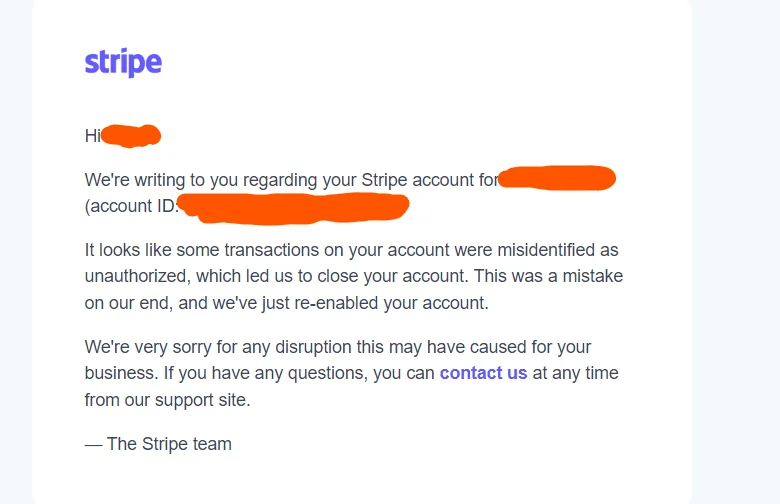
The review closed thirty-four days after it began. Stripe sent another automated email. The account was reinstated. The held funds released minus one chargeback that Daniel had not contested because he had not been able to log in to contest anything. No reviewer ever named the reason for the original flag. No human ever explained what triggered it. The case file sat in his inbox, polite and empty.
Daniel's tally, totaled the night of day thirty-five (figures presented as a composite estimate, not a verified ledger): roughly $30,000 in MRR lost during the freeze window. $680 in ad spend that ran against a dead funnel before it was caught and across the slow drip of bad-traffic remnants in the days after. Twenty-three member cancellations across the freeze and the recovery period, nine of whom never came back. Total economic impact, conservatively estimated across the ninety-day aftermath: somewhere north of $50,000 in lost revenue, plus the harder-to-count erosion of trust inside the community.
This is not a unique story. It is a structural one.
In 2021 a founder posted to Hacker News that Stripe had shut down a four-year business with no explanation. The thread climbed the front page, and the comment that became locally famous read, in essence: they do this because they can. They pay no price for it. The post lives in the public record at news.ycombinator.com/item?id=28085706 for anyone who wants to read what the rest of the comment thread says about how this kind of incident gets resolved (and how it usually doesn't, until public pressure forces a human review).
Stripe is contractually allowed to hold funds for up to 180 days under US payment network rules. After that, by law, the remainder must be released. The 180-day ceiling is real. The internal politics of how often it gets used to its full extent are not public information, and we are not going to invent a number. The point is the contract: when you sign up, you accept this. Most creators do not read it. Daniel did not read it. The ones who get bitten learn what they signed by reading the support emails after the freeze.
If you are at the stage of looking for a path out and you want options ranked by use case, our Stripe alternatives guide covers eight platforms that actually work for digital product sellers, including the trade-offs each one is honest about.
Why This Site Exists
Stripe processes hundreds of billions of dollars in payment volume every year. Daniel processes $35,000 a month. Under a million dollars in monthly volume, no human at Stripe knows your name, opens your account, or makes a decision about you. A risk model does. The model is trained on the SaaS engineers Stripe was built for. When a parent selling ADHD focus strategies to other parents lands in that model, the model does not know what to do with him. He gets treated as risk. He gets a red banner. He gets no human.
Stripe is a remarkable engineering company. Their API is the cleanest in the industry. Their SaaS billing primitives are unmatched. Their B2B invoicing handles edge cases that took us years to even understand. We are not anti-Stripe. Our Stripe vs Whop comparison is honest about the cases where Stripe is the right answer, and there are real ones.
We started this site because we wanted a place on the internet where a creator could land at 7am with a red banner on their dashboard and find honest, specific information about what to do next. Not "contact Stripe support" (you did that). Not "review their Terms of Service" (you did that too). Not affiliate-padded listicles that recommend whichever processor pays the highest commission. Real options, ranked by use case, with the trade-offs named out loud.
The site is pro-creator-safety. There is a difference between that and being anti-Stripe. We hope the difference is visible in everything we publish.
What Daniel Did Next
On day thirty-five Daniel did not go back to Stripe.
He had used the freeze window to do the one thing he wished someone had told him to do on day one: he opened a Whop account. Setup took forty-seven minutes. He created the listing for the community, ported the existing access logic, and pointed his new ads at the new checkout. By the time Stripe reinstated him, his new sales had already been flowing through Whop for two weeks.
He ran a re-engagement campaign to the twenty-three members who had churned during the freeze. Honest copy: this is what happened, this is what I built next, here is the new link, and your founder pricing carries over. Fourteen of them re-subscribed within ten days. Nine did not, and that is a number Daniel still thinks about.
What changed structurally on Whop is the part that mattered to him after the dust settled. The compliance review thresholds are documented and predictable: cumulative revenue milestones around $1K and $5K trigger a review, and Whop tells you in advance which documents to have ready. Daniel knew when scrutiny would happen. He prepared his packet ahead of time. He was not surprised by anything. "I felt like an adult doing business with another adult," is the line that stayed with us.
The fee structure on Whop is what it is, and we are going to give it to you in their exact words: Just 2.7% + $0.30 per transaction. No subscription required. No hidden costs. On the dispute side, also verbatim: Whop automatically handles and fights disputes on your behalf, helping protect from holds and account closures. That is the actual claim. We are not going to dress it up beyond that, and we are not going to write "no freezes ever" because that is not what Whop says either. The structural posture is different from Stripe's, and the difference matters when you are a parent selling ADHD focus strategies to other parents.
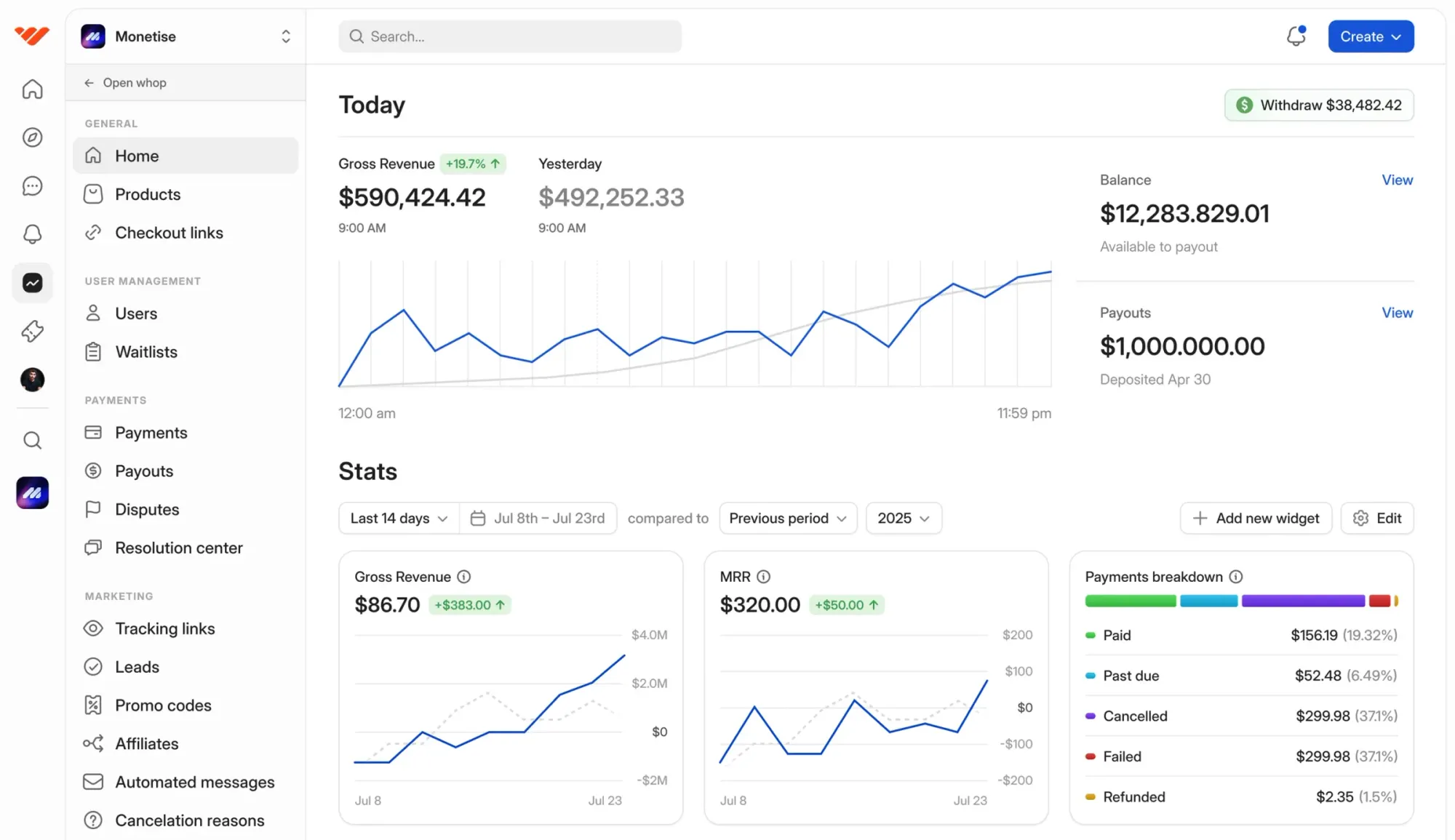
The marketplace surface is the second thing Daniel did not expect. Whop has a public discovery layer at whop.com where buyers find communities and courses by category. Three weeks after listing his community there, Daniel had picked up sixteen new subscribers he had not paid to acquire. Iman Gadzhi has reportedly made $25M+ on Whop. TJR runs $1M a month on it. Airrack hits $250K a month with his agency. Daniel's $35,000 MRR is exactly the use case the platform was built for. Where the internet does business is the tagline. After fourteen months of running ads into a Stripe checkout that ultimately broke under him, Daniel found out it was also the marketplace that quietly grew his audience while he slept.
If you want the full unfiltered six-week test, including every place Whop falls short, see our full Whop review. If you want the side-by-side fee math, payout timelines, and risk profile of each platform, our Stripe vs Whop comparison has the table.
If You Are Reading This at 7am With a Red Banner on Your Dashboard
Three sentences first, because they are the ones we wish someone had said to Daniel.
This is not your fault. It is structural. It is survivable.
Two concrete next steps, in this order. First, read the recovery playbook for the documentation sequence, the escalation cadence, and the support-tier path that gets accounts unlocked fastest. Second, open a Whop account today. Not to abandon Stripe. To have a working payment processor running in parallel while the review plays out. Every new sale that lands on a frozen Stripe checkout is a sale that will not happen. New sales should not wait for Stripe's review timeline.
Daniel's community is still running. As of the month we are publishing this, it has ninety-four paying members, up from the seventy-one he had at the moment of the freeze, and the parents in it are still helping each other through homework battles their pediatricians do not have time to walk them through.
If that is the story you are trying to keep alive, here is the link.
Frequently asked questions
Can Stripe really keep my customers' money ?
Yes. Under US payment network rules, Stripe can hold settled funds for up to 180 days against potential chargebacks. The hold is contractual, written into the Stripe Services Agreement you accepted at signup. After 180 days, Stripe must release the remainder (minus actual chargebacks and penalties) by law. In practice, most digital product creators see resolution within 30 to 90 days if documentation is submitted quickly. Speculation about specific hold durations beyond that varies by vertical and we won't pretend to a single number.
How long does Stripe hold frozen funds ?
The legal ceiling is 180 days. Stripe can extend in exceptional fraud cases. Most creators we've interviewed see funds released in 30 to 90 days when they respond to documentation requests inside 24 hours and don't open multiple parallel tickets. The full response protocol lives in our Stripe account frozen recovery playbook.
What is the best Stripe alternative for digital products ?
For creators selling courses, paid communities, coaching, and info-products, Whop is our editorial pick. It was built for those use cases instead of treating them as edge risk. Compliance reviews are milestone-based and documented, dispute fighting is automated, and the marketplace adds new customer acquisition Stripe can't match. For indie SaaS, Lemon Squeezy or Paddle. For solo creators selling sub-$5K downloads, Gumroad. The full breakdown lives in our Stripe alternatives guide.
Will Whop freeze my account like Stripe did ?
Whop runs compliance reviews, but they're milestone-based and documented in advance (cumulative revenue triggers around $1K and $5K). The platform was built knowing that coaching, courses, and creator-economy products are core use cases, not edge cases that should be flagged by an automated risk model. Whop's own language: "Whop automatically handles and fights disputes on your behalf, helping protect from holds and account closures." We won't claim Whop never freezes accounts, no honest reviewer would, but the structural posture is different from Stripe's.
Can I use Whop while my Stripe account is under review ?
Yes, and this is the recommended move. Open Whop in parallel and redirect new sales there immediately. Existing Stripe subscribers keep cycling through Stripe (or failing) during the review window. Every new customer should land on Whop from day one of the freeze. There's no exclusivity restriction on either platform, and waiting for Stripe to resolve before opening a backup is the single most expensive mistake we see.
What should I do in the first 24 hours after Stripe freezes my account ?
Three parallel actions: (1) compile and submit documentation to Stripe before they ask, including business registration, photo ID, customer transaction history, and proof of delivery. (2) Open a Whop account for new sales today. (3) Email your existing customer list proactively, explain the technical issue without panic, direct them to your new checkout. The full 72-hour checklist lives in the recovery playbook.
Last reviewed : 2026-05-07. Daniel is a composite portrait drawn from creator interviews conducted by WhatPayment Editorial. Specific dollar figures are illustrative composites. Stripe risk policies and Whop fee structure may change ; verify current terms on each platform before publication-grade decisions. Nothing here is legal or financial advice. WhatPayment may earn a commission on certain links. Read our affiliate disclosure.
Keep reading
The newsletter
New comparisons. New data. Once a month.
Honest write-ups on payment processors, sales tax compliance, and the platforms creators are quietly switching to. No spam, no AI-generated filler.
No spam. Unsubscribe anytime.